Working Out With Kids Underfoot: The Home Training That Survives Family Life
The home workout’s biggest opponent isn’t motivation — it’s the small human who needs a snack mid-set — and the training that survives family life is designed for interruption, not protected from it. The kids-underfoot guide: the design, the involvement and the systems.

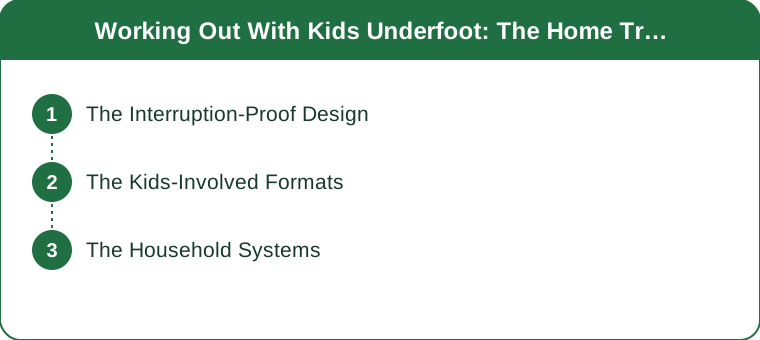
The Interruption-Proof Design
Sessions built to bend: the circuit architecture (the full-body circuits where any stopping point is fine — the straight-sets program’s fragility versus the round-based resilience; the workout that pauses at any rep per the mama doctrine), the ten-minute-block system (the session as stackable blocks — the one-block day counting fully per the minimal doctrine; the three blocks across a morning equaling the hour that never happens), the no-setup rule (the bodyweight-and-band emphasis from the home doctrine — the equipment that deploys in seconds; the barbell-complexity deferred to solo windows), the pause-friendly exercises (the moves droppable mid-set safely — the kettlebell parked, not pressed, when the crash sounds; the awareness-split honesty per the safety doctrine), the resume protocols (the interruption handled and the NEXT round started — the restart drama deleted per the flexibility doctrine; the workout judged by rounds completed, not continuity), and the expectations reset (the fragmented session being the SEASON’S normal — the comparison to childless workouts retired per the season doctrine).

The Kids-Involved Formats
Training as family activity: the copy-me workout (the kids doing kid-versions alongside — the squats-and-animal-walks that toddlers love; the modeling dividend from the family doctrine: the movement normalized by watching), the kid-as-equipment games (the toddler-weighted squats and the airplane presses from the mama doctrine — the safety rules: the floor-based lifts, the full-attention sets; the giggles counting as cardio), the obstacle-course sessions (the living-room course built together — the crawl-jump-balance circuits from the play doctrine; the parent demonstrating being the parent training), the timer games (the ‘how many can mommy do in one minute’ format — the kids as scorekeepers; the counting practice smuggled in per the family doctrine), the dance-party cardio (the three-song dance blocks from the dance doctrine — the whole-family cardio that needs no explanation), the baby-wearing options (the carrier squats-and-walks from the mama doctrine for the youngest tier), and the age-scaling honesty (the involvement changing by age — the toddler’s chaos participation, the school-kid’s genuine joining, the teen’s eye-rolling from a distance; the seasons rolled with per the family doctrine).
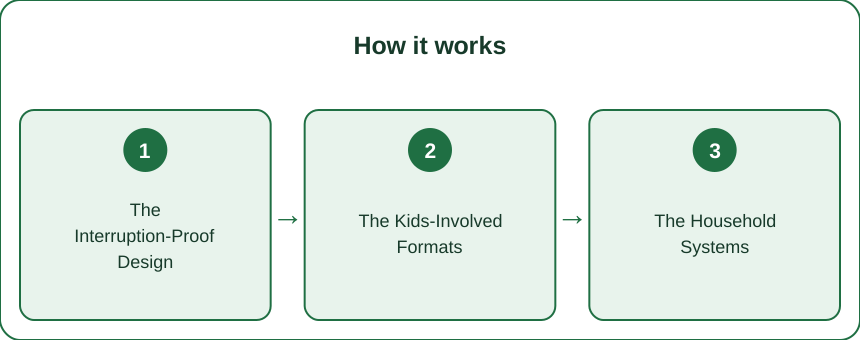
The Household Systems
The support structure: the window mapping (the household’s real gaps found — the nap slots, the post-breakfast independent-play window, the partner-handoff evenings from the mama doctrine; the training scheduled to the family’s rhythm, not against it), the partner treaty (the traded protected slots from the household doctrine — the each-parent-trains agreement; the weekend morning swaps), the environment staging (the workout corner always ready from the staging doctrine — the mat visible, the band on the hook; the ten-second start that beats the closing window), the independent-play investment (the play skills built BEING the workout infrastructure — the busy-box rotation for training blocks; the screen-honesty clause: the occasional show-length workout being fine parenting per the pragmatism doctrine), the guilt release (the interrupted, fragmented, kid-punctuated training counting COMPLETELY — the done-is-done doctrine; the parent who trains imperfectly outpacing the one waiting for perfect), the identity note (the kids growing up watching a parent who moves — the two-generation dividend from the modeling doctrine), and the closing frame (the family-proof workout as a design achievement — the circuits that bend, the kids who join, the windows that get used; the fitness kept THROUGH the chaos, which is the only way it survives it). Circuits not straight sets, blocks not hours, kids in not shooed away: the training, family-proofed.
Design for interruption: round-based circuits where any stopping point is fine, stackable ten-minute blocks, no-setup equipment, and a judged-by-rounds mindset. Let kids join — copy-me squats, obstacle courses, timer games — and map training to the household’s real windows with a partner-traded protected slot.
Keep Reading
This article is for general informational purposes only and is not medical advice. It is not a substitute for professional diagnosis or treatment. Always consult a qualified healthcare provider about your individual situation, especially before making significant changes to your diet or exercise routine.